Showing posts with label Engineering. Show all posts

هندسة البيونيك Bionics


هندسة البيونيك ...


البيونيك هو فرع من الهندسة يحاول فيه المهندسون تقليد الطبيعة. كان من أول من إستعمل و نشر هذه اللفظة الميجور في سلاح الجو الأمريكي جاك ستيل وهي دمج لعبارة بيولوجيا و تقنية
لتصير بيونيك و ذلك للدلالة على أنه يمكن الإستفادة من الطبيعة و تصاميمها في المجالات التقنية.

Paris apartment of Ivan Miplera


Visiting Paris apartment of Ivan Miplera, creative director at Diane von Fürstenberg, is like a visit to a parallel woprld – it gives you a strange impression of space and it has been equipped by the designer itself.


Having been inherited, the apartment is situated on one of the side streets of Paris near Canal Saint-Martin. It was built in the late XIX century and it was in a general good condition. The biography of the place states that for a while the apartment belonged to a circus school.


”I wanted it to look chic and modern, but quite unusual – surreal.” says the owner.


The huge black cube with faceted surfaces hides the kitchen area.

“I like modernism, so, I wanted to have a modern apartment – he explains. – But I don’t like the cold materials associated with this style. So I chose hand-made, warm and luxurious things. My apartment is a cozy and quaint little nest where I can escape from the bustle of Paris.”

Mitigating Elevator Noise in Multifamily Residential Buildings


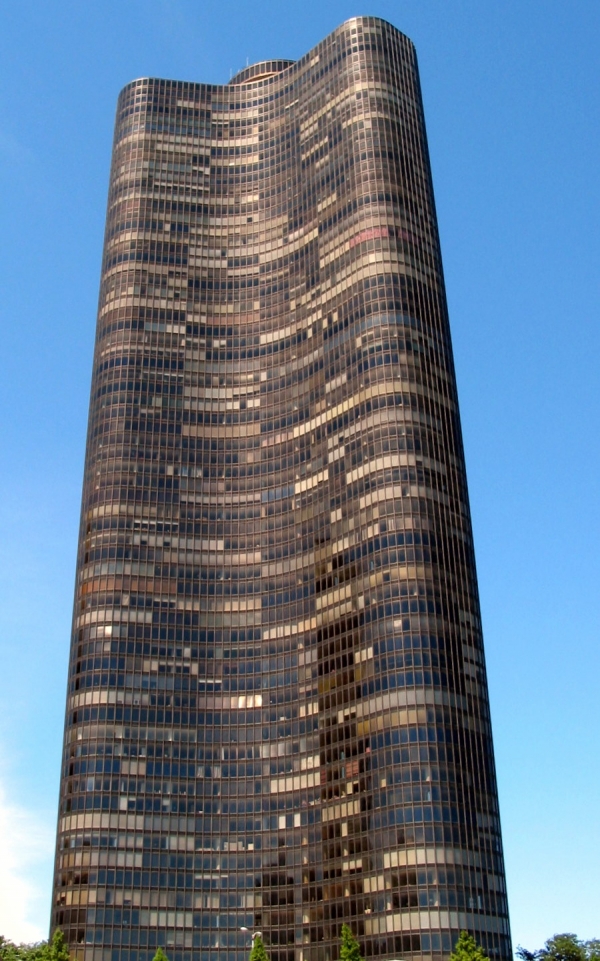
Lake Point Tower, Chicago, IL


Today’s modern mid rise and high rise luxury condominiums and apartment buildings offer numerous amenities to attract potential owners. They can offer spectacular vistas through floor to ceiling walls of glass, high end finishes on the floor, gourmet style kitchens with all the modern features one could ever want, and a master bedroom suite that offers a tranquil and quiet place to escape. In these building types, elevators become a necessary component for vertical circulation to access the floors. For those residences that are adjacent to the elevator equipment room or the elevator hoistway, the noise and vibration caused by the operation of the elevator can be a potential source of sound intrusion. Because today’s buildings are constructed with lightweight materials, and because there is a need to generate maximum useable square footage, sound transmission issues are compounded. All this combined can result in unsatisfactory living conditions for tens of thousands who live in condominiums or apartments.


The acoustical environment of each residential unit must be taken seriously by both the architect and the developer during the design and planning phase of a project . The operation of elevators will generate significant sound and vibration, which needs to be considered due to the potential impact on adjacent residences. To specifically address these issues related to elevator noise is a challenge. It can be very complicated to identify the source of noise, be it air-borne or structure-borne, after the construction is complete. Many of the impact noises result from structure-borne transmission issues that are not easily calculated or projected prior to the actual construction of each specific project. Additionally, it is difficult for elevator manufacturers to quantitatively produce sound level data for their systems, due to each individual project being uniquely different.

To lessen any future litigation and as part of providing due diligence, it is recommended that a consultant who specializes in architectural acoustics be a part of the design team. An experienced acoustical consultant can provide the architectural team with a number of design options early in the design phase, as well as help explore options to meet the necessary acoustical needs of the facility. Addressing sound isolation and acoustic privacy from mechanical system noise and vibration is a critical part of the final success of the project.
Sound Transmission Class

Sound is the vibrations transmitted through an elastic medium such as a solid, liquid or gas, with frequencies that range from 20 to 20,000 hertz. This is the frequency range which is typically capable of being detected by human ears. Since it requires an elastic medium, sound cannot travel through a vacuum. The more elastic a substance, the better it will conduct sound. An example of this would be comparing lead with steel. Lead is considered inelastic and thus will not conduct sound very well. Steel is considered elastic, making it an exceptional conductor of sound.

A standard by which the construction industry uses building materials for sound attenuation is known as the Sound Transmission Class (STC). The Sound Transmission Class is a number rating of a material or an assembly's ability to resist air-borne sound transfer at frequencies 125-4000 Hz. This range represents the speech frequencies. In general, a higher STC rating will block more noise from transmitting through a partition or assembly. However, STC ratings do not take into account low frequencies below 125 Hz. The ratings are based on laboratory testing and do not take into consideration weak links within the wall assembly such as joints, penetrations and gaps around the perimeter of the wall assembly.

The STC number is derived from sound attenuation values tested at sixteen standard frequencies from 125 Hz to 4000 Hz. These transmission-loss values are then plotted on a sound pressure level graph and the resulting curve is compared to a standard reference contour. Acoustical engineers interpolate these values to determine an STC rating.

Changes in STC with Resulting Changes in Apparent Loudness
STC Rating Change Apparent Loudness Change
+/- 1 Barely Imperceptible
+/- 3 Just Perceptible
+/- 5 Clearly Noticeable
+/- 10 Twice (or half) as Loud


Typical Examples of Sound Levels
Source of Sound Decibel (dB)
Calm Room 20-30
Normal Human Speech 40-60
Moving Car from 30'-0" Away
60-80 

Traffic Noise on a Major Road from 30'-0" Away
80-90 

Typical Jackhammer
100 

Jet Engine from 300'-0" Away
110-140 

Hearing Damage Begins with Short Exposure
120 

Human Threshold of Pain
130 


Another form of sound measure is impact or structure-borne noise known as Impact Insulation Class (IIC). This rates a floor/ceiling assembly’s resistance to the transmission of structure-borne or impact noise. Achieving a higher IIC rating, such as 70, does not always ensure that footfall noise will be totally eliminated. Of all noises, totally eliminating the impact noise of footfall is very difficult.
Sources of Elevator Noise


The air-borne sound and vibration from elevator systems can result from a variety of sources and transmission paths. Several of the more significant sound sources are:
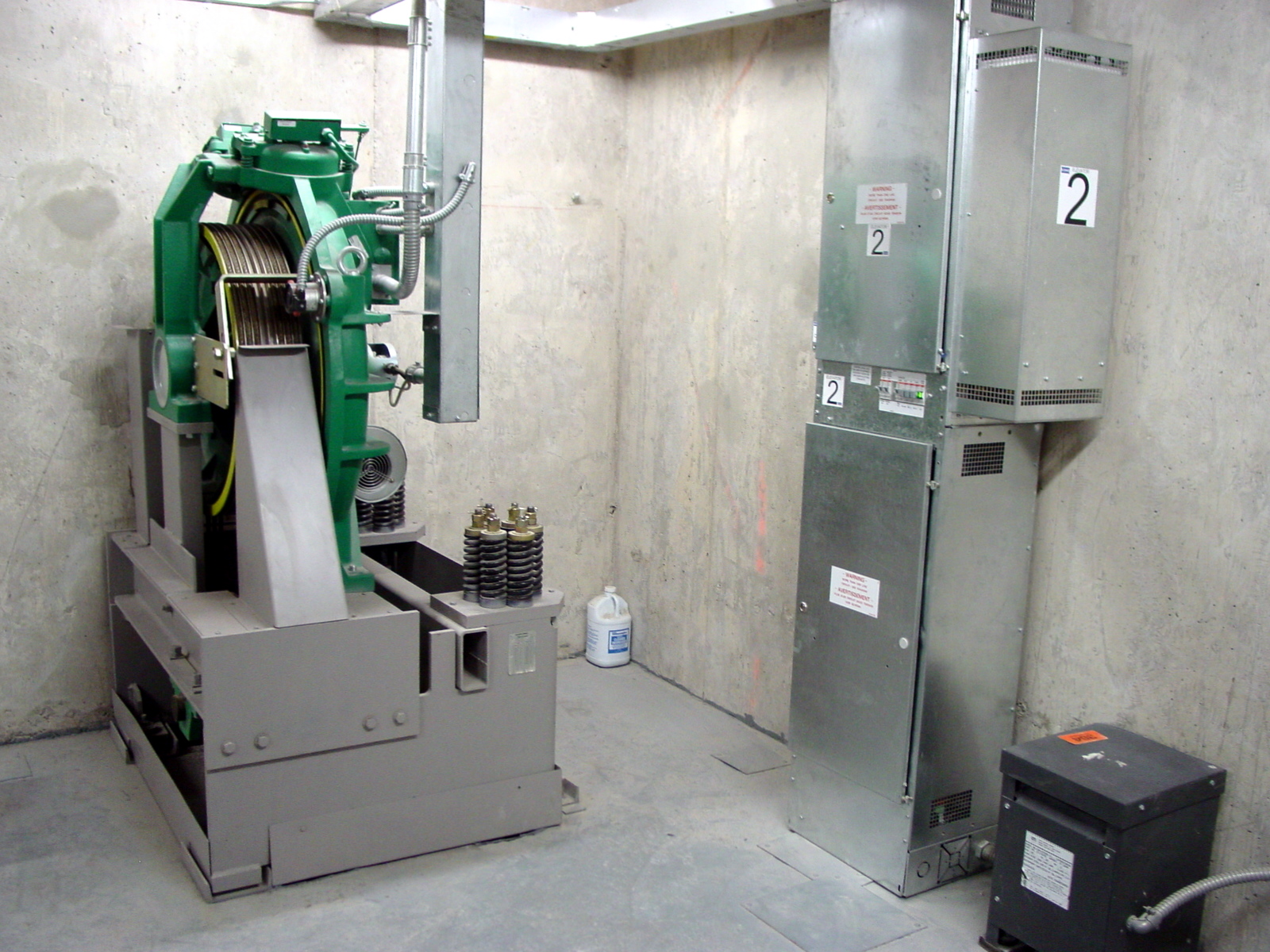
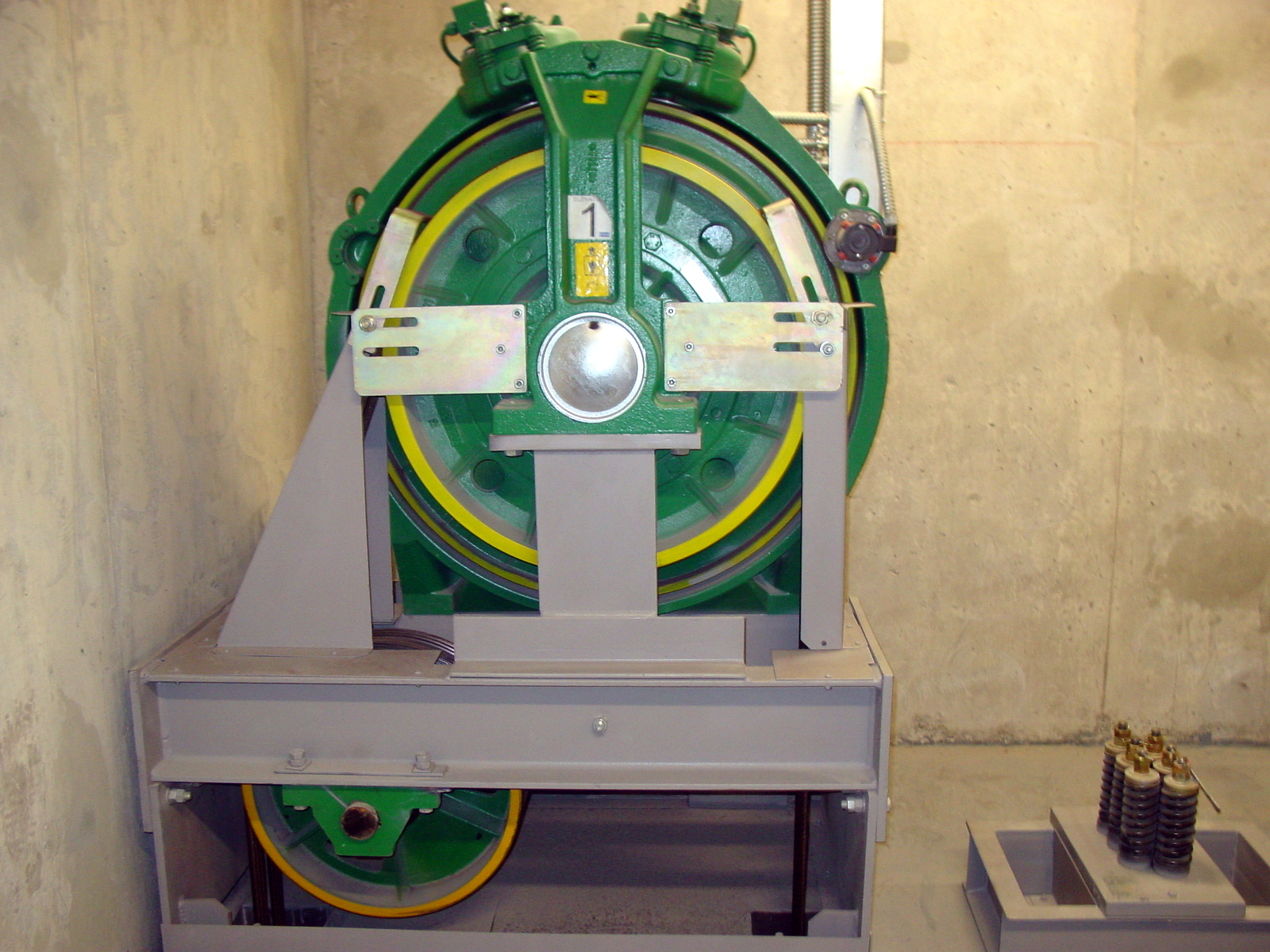
Tonal noise from traction elevator hoist machinery
Tonal noise from switchgear for traction elevators
Hydraulic elevator pumps and machinery
Transient noise from poorly adjusted elevator car guide rollers or bumps in rails
Elevator doors
Door enunciators

Machine-Room-Less Elevators have a drive system that is supported by the rails. Therefore, the vibration generated at the time an elevator runs can easily be transmitted to the hoistway enclosure from the rails. For this reason, architects need to be cautious of generating structure-borne noise by the vibration from the hoistway to adjoining rooms.

Most of the sound energy will be transmitted by the separating wall assembly itself, but there are many opportunities for "flanking paths" or "sound leaks" to occur. Some of the common air-borne sound transmissions through flanking paths in buildings are:
Plenums and suspended ceilings
Ducts with no sound attenuation material
Transoms and air grilles
Unblocked ceiling plenum spaces
Wall perimeters with no acoustical sealant
Ducts, piping, electrical devices and fixtures
Masonry joints

Sound travels not only in a straight path from its source but also bounces off partitions, bends around barriers, and squeezes through small openings, all of which can allow noise to reach surprisingly far beyond its point of origin.
Basic Principles for Controlling Sound

In general, loud speech can be understood fairly well through an STC 30 wall, but should not be audible through an STC 60 wall. An STC of 50 is a common building standard and blocks approximately 50 dB from transmitting through the partition. However, occupants would still be subject to some barely audible sounds of loud speech. Wall assemblies with a higher STC such as 60 would be as much as 10dB better. For particularly sensitive areas where sound transmission is a concern, this higher STC rating should be installed.
A separate wall around the perimeter of the elevator hoist must extend to the structural deck in order to achieve optimal isolation. Walls extending only to a dropped ceiling will result in a flanking path for sound.
Sound will travel through the weakest elements, such as doors, plumbing penetrations or electrical outlets.
When the mass of a barrier is doubled (increasing the STC rating), an increase by approximately 5 dB will be gained. This increase will be clearly noticeable.
Installing insulation within a wall or floor/ceiling cavity will improve the STC rating by about 4-6 dB, which is also noticeable.
Metal studs perform better than wood studs. Staggering the studs or using dual studs can provide a substantial increase in isolation.
Increasing air space in a wall assembly will also improve isolation.

Building codes such as The Uniform Building Code (UBC) and International Building Code (IBC) contain requirements for sound isolation between adjacent dwelling units or between dwelling units and adjacent public areas such as halls, corridors, stairs or service areas. These codes also apply to hotels, motels, apartments, condominiums, monasteries and convents.
Code requirements for walls: STC rating of 50 (if tested in a laboratory) or 45 (if tested in the field).
Code requirements for floor/ceiling assemblies: STC and IIC ratings of 50 (if tested in a laboratory) or 45 (if tested in the field).

An assembly rated at STC 50 will satisfy the building code requirement. However, as mentioned above, occupants could still be subject to awareness, if not understanding, of loud speech. Therefore, it is typically expected that luxury accommodations have a more rigorous design goal. When field testing is done, this evaluates the dwelling's actual construction assembly and includes all sound paths.
Typical STC Ratings for Masonry Walls

STC ratings for masonry and CMU walls are based on the weight of the block. Improved performance can be achieved by filling the cells with additional materials as shown in the chart below.
Estimated STC Ratings for CMU Walls

Wall Thickness, Inches Hollow Units Grout Filled Sand Filled
Weight STC Weight STC Weight STC
4 20 44 38 47 32 46
6 32 46 63 51 50 49
8 42 48 86 55 68 52
10 53 50 109 60 86 55


The STC rating of a CMU wall can be estimated based on its weight using the following formula:
STC = 0.18W + 40

Where W = pounds per square foot (psf)

There are many unique factors that can change the final STC calculations. The estimate could be off by as much as +/- 4 dB. There are numerous other issues that need to be addressed to get a more accurate calculation.
Improving STC Rating of Walls

While the science behind sound is well understood, using that science to create the desired acoustical quality within a building or room is complex. No single acoustical solution can be universally applied to all designs. Each environment features unique parameters that the architect and designer must consider when developing floor plans, selecting materials, and designing assemblies. Virtually every material from furniture and wall and floor coverings to computer equipment will affect sound to some degree. However, designing wall partitions, ceiling systems and floor/ceiling assemblies for the distinct qualities of a space will achieve the most effective sound control.
Adding mass: When the mass of a barrier is doubled, the isolation quality (or STC rating) increases by approximately 5 dB, which is clearly noticeable.
Air space: airspace of 1 ½" will improve the STC by approximately 3 dB. An air space of 3" will improve the STC by approximately 6 dB. An airspace of 6" will improve the STC by approximately 8 dB.
Cavity insulation: installing insulation within a wall or floor/ceiling cavity will improve the STC rating by about 4-6 dB, which is clearly noticeable.
Sound Suppression Guidelines for Noise Reduction
The surrounding walls, floor, and ceiling assembly should have a substantial STC rating. If noise sensitive areas are nearby, STC 50 or 55 at a minimum should be used as the design criteria for the surrounding structure. All cracks and gaps around the perimeter must be filled with the appropriate acoustical caulking.
In situations where noise-sensitive areas are not an issue, two layers of drywall (four total) are still recommended, and the area around the perimeter should be sufficiently caulked. Double-layer drywall with staggered seams works best.
Doors must have a good STC rating. A rated door and frame assembly are needed if a noise-sensitive area is nearby. Ideally an STC 55 door system would be best, to match the walls. Rated doors may have cam hinges that raise the door and then lower it when it closes to eliminate the gap at the base and a tight seal around the perimeter, along with sufficient mass to give the door a good STC rating. Doors with a lower rating, such as STC 40, may be adequate for a non-noise sensitive areas.
If a standard door is used, good sealing hardware is needed to seal around the perimeter of the door.
Penetrations through the equipment room walls must be kept to a minimum. When pipes and conduit pass through the walls, they must be sealed with mortar or the appropriate acoustical sealant to prevent noise leaks. A heavy, solid material must be used. Do not use fiberglass.
If the walls are concrete block, do not paint them. Unpainted block has about 33% absorption, which is lost with a coat of paint. Fiberglass panels on the ceiling or walls covering 25% of the area are beneficial, but not mandatory.
Vibration isolation of the elevator machinery normally will not be needed when the unit is attached to a concrete foundation. If used on elevated floor slabs, 2” deflection springs properly sized and installed are suggested.
Conduit from the power unit to the hoistway should be “vibrationally” isolated from the wall and the perimeter of the pipe should be sealed with the appropriate acoustical sealant to prevent acoustical leaks or flanking paths for vibration noise.

Regardless of the building type, elevators will generate considerable amounts of noise and vibration. In acoustically sensitive spaces, such as residences around the machine room and hoistway, it is important that the design team review all guidelines and criteria carefully. With the input of the elevator manufacturer, the structural engineer and the architect, the sound and vibration from the operation of elevators can be successfully mitigated.

Extruded Polystyrene (XPS): Improved Wall Performance


A building's wall system must constantly fight the invasion of rain, air, vapor and thermal attacks.The wall's ability to provide a barrier to each of these elements relies upon the use of appropriate materials, installed in the correct sequence. There is no such thing as a perfect wall system; however, a wall system that performs with greater efficiency using new efficient materials is achievable.


Steel stud wall construction, even though it is a versatile system, presents a set of challenges that are different from those of wood frame construction. Two major problems exist with steel stud walls that need to be managed: control of moisture and thermal conductivity. As an example of thermal conductivity, steel studs can transfer heat approximately 400 times faster than wood studs. Additionally, when insulation becomes wet, it will decrease the wall system's R-valueas well as contribute to mildew development inside the wall. “R” refers to the resistance to heat flow. As the R-value or RSI number increases, the resistance to thermal transfer becomes greater. RSI is the metric equivalent of the R-value.

Many years of research and study have gone into all the components of a wall system, and this research will continue for years to come. As a result of our better understanding how rain, air, vapor and thermal issues affect a conditioned interior space, many products have been improved upon and new innovations have emerged to provide a more effective wall system. With a finite supply of fossil fuels and greater awareness of energy conservation, the need for a more thermally efficient wall system has become important. As such, a greater emphasis has been placed on the role of insulation and its location within the wall assembly. The need to design energy-efficient buildings that are still economically feasible to construct has become imperative.

Extruded polystyrene insulation, also referred to as XPS, installed as an exterior insulating material and as part of the metal stud wall assembly, has been shown to provide a far more efficient system than fiberglass insulation. Eliminating thermal bridging issues and at the same time resisting moisture, XPS is an ideal solution that should be considered for any metal stud wall system.
Metal Stud Wall System Anatomy

Concrete masonry units (CMU) have long been considered the ideal backup material for brick facing; however, because of increasing installation costs, CMU backup systems have given way to metal stud backup systems. Brick veneer with metal stud backup walls, because they are a very cost effective and versatile wall assembly, are very commonly seen in today’s commercial buildings. The original exterior metal stud wall systems of the 1970’s were simple. They consisted of metal studs at 16 or 24 inches on center, with fiberglass batt insulation having an integral vapor barrier placed in between. Gypsum board sheathing was placed on each side, and 15 pound felt paper was installed over the exterior sheathing. This system eventually would fail and allow air and moisture to enter the building, degrading the insulation and thus the R-Value of the wall, not to mention causing other significant problems.

The Brick Industry Association (BIA) has issued a revised Technical Note #28B that describes in detail Brick Veneer/Steel Stud Wall Construction. The following is an abbreviated summary of their minimum recommendations:
The allowable out-of-plane deflection of the studs due to service level loads should be restricted to L/600 to L/700.
The minimum air space should be increased to 2 inches.
Ties must be spaced closer. There should be one tie for each 2 sq ft (0.18 sq m) of wall area.
Sheathing should be upgraded. Possible choices include: closed-cell rigid insulation meeting ASTM C 578 or C 1289 at a minimum of 1/2" thick; exterior grade gypsum sheathing, OSB or glass fiber mat-faced sheathing or cement board at a minimum of 1/2" thick.
A water-resistant barrier should be installed over sheathing.

Brick veneer with metal stud backup is typically a vented wall system. This is to provide a way out for any moisture that enters the wall system through the brick joints or other openings. A vented cavity also allows for pressure equalization of external pressures caused by wind loads. Venting is accomplished by providing weeps or vents immediately above the wall flashing. Open head joint weeps are recommended with a spacing of no more than 24 inches on center. BIA recommends that wick or tube weeps, when used, be spaced no more than 16 inches on center.

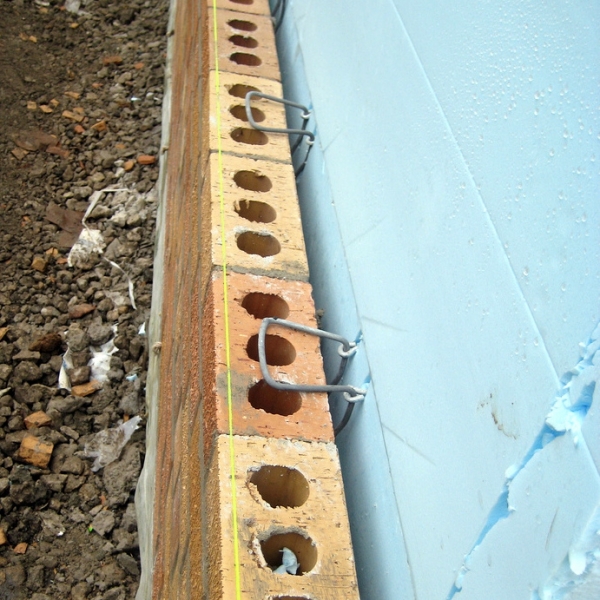
BIA recommends four types of adjustable masonry anchor assemblies for brick veneer/metal stud systems. Each of these is connected to the studs with metal screws. Due to thermal bridging at the stud, condensation can form on the inside face of the stud’s outside flange during long term cold conditions if a thermal break is not provided. When using XPS as part of the exterior system, brick ties that connect directly to the framing must not rely on the compressive resistance of the exterior sheathing material to transfer positive wind loads to the steel studs. This will eliminate the thermal bridge issue at brick ties. All anchors must be embedded at least 1 1/2 inches into the brick veneer with a minimum mortar cover of 5/8 inch to the outside face of the wall.
Improve Wall Performance: Design Options

As long as there is a temperature difference from one side of a wall to the other, heat will transfer from warm to cold. As the thermal resistance in the wall increases, the rate of heat transfer will decrease.

By incorporating a moisture resistant thermal barrier on the exterior side of metal studs, many moisture and thermal issues can be better managed. Extruded polystyrene insulation is specifically designed for wet locations, and yet provides excellent thermal efficiency as a part of the wall assembly. It is the closed-cell structure of the insulation boards that helps resist water and water vapor. For every inch thickness of XPS, an R-Value of 5.0 can be expected. XPS boards come in thicknesses ranging from 1 inch to 3 inches, many with a shiplap edge treatment on the long side. No matter the edge condition, all joints between the insulation boards need to be sealed as recommended by the manufacturer. This is typically done with a butyl type insulation tape.

Detailing and constructing a metal stud cavity wall system using XPS insulation boards can be done in one of three possible ways. In each of these cases, the steel stud wall system is either 4 or 6 inches, with brick veneer and a 2 inch air cavity as the exterior finish system:
Interior and exterior gypsum sheathing on each side. Uninsulated stud cavity. Continuous XPS insulation board over an air barrier membrane covering the exterior sheathing.
Interior gypsum board sheathing only, no exterior sheathing. Uninsulated stud cavity. Continuous air barrier membrane over XPS insulation board attached directly to the metal studs. The steel stud wall assembly will require additional bracing.
Interior and exterior gypsum sheathing on each side. R-11 batt insulation in wall cavity. Continuous XPS insulation board over an air barrier membrane covering the exterior sheathing.
Installation Best Practices

It is critical to install XPS correctly in order for the wall system to function properly. Insulation also provides the necessary comfort for the buildings occupants.

Wherever there is a thermal bridge in the wall system, condensation will occur on the surface where the temperature differences between the interior and exterior are greatest. When fiberglass batt insulation is installed between the metal studs, the exterior flange of the metal stud behind the brick veneer will be exposed to the colder temperatures. The low R-value of exterior sheathing material is not sufficient to eliminate thermal bridging at these locations. In this case, the exterior flange of the metal stud will be subjected to condensation. Brick veneer ties are the weak link, providing a short circuit for thermal bridging. All brick ties are connected to the metal studs by way of metal screws. Approximately two threads of these screws will grip the 16-gauge outer flange of the metal stud. With repeated condensation, rust and corrosion will begin to develop at the juncture between screw and stud. After several years, the brick veneer anchors could begin to fail, resulting in excessive brick movement and cracks forming in the mortar joints. This will allow additional water to infiltrate the building envelope.

A relatively easy solution to this problem is installing a continuous layer of XPS board to the exterior sheathing. When as little as 1 inch of XPS board is installed to the outside face of the exterior sheathing, which also prevents thermal bridging, the temperature at the interior gypsum will increase. A vapor retarder is still required, and in this case it is located between the exterior gypsum board and the XPS. An important step to preventing moisture from forming as condensation in a wall is to keep the wall cavity warm. Thermal bridging will increase the chances of condensation and thus reduce the R-Value of the batt insulation by as much as 50%.
Common Construction Pitfalls

Common pitfalls in designing and installing the thermal barrier include incorrect location and the creation of voids in the thermal barrier. Other problems include installing other materials that create a short-circuit or thermal bridge at the insulation layer.

As an example, if the XPS boards are installed incorrectly, leaving gaps of up to 3/4 inch between uneven edges of the insulation, the overall R-Value of the wall system will drastically be compromised. Tight fitting edges and corners are essential as well. Cut outs for masonry anchors are another problem that needs to be avoided. Correct masonry veneer anchors must be used.
Conclusion

Metal stud backup wall systems offer a cost-effective and rapid way to enclose a building's exterior walls. They are also proving to be reliable alternative to traditional CMU back-up systems. With proper detailing and construction, the metal stud wall can perform successfully for many years. The performance of the building’s wall enclosure depends on the proper installation sequence, clear detailing of each of these barriers, and on the ability to provide proper ventilation of concealed building materials to allow for adequate drying from occasional moisture exposure, without deterioration ormold contamination.

An informal, sturdy and stylish office building


An informal, sturdy and stylish office building


Recently, in Rozenburg (The Netherlands), the new office building was completed for Qualm, a contracting firm for earthwork, road- and waterworks. The building and interior are designed by Sputnik Architecture Urbanism Research from Rotterdam.

The working method of the company was the starting point for the design of the building. On the one hand, there is a need for concentration workplaces. On the other hand, the company is organized horizontally and informal communication determines the successful operation of the company.

The staff has their own workstations in rooms with different sizes for the different departments. These areas have a radiant white, design.
Especially for informal consultations and meetings the usual standard office hallway is transformed into a 3D walkway. This is an attractive area in which voids with stairs connect the three floors of the building spatially. The floors, the ceilings, the stairs, the office windows and parapets are all made of Ash. This creates a contrast between the formal and the informal atmosphere in the building.

The building stands on the site where the company Qualm has long been established, in an industrial business park of the 1960s. The building fits in this robust context with a modestly designed façade. Behind the aluminum paneling an inventive, sustainable VRF air conditioning system is hidden. All piping and equipment are incorporated in the parapet, leaving no need for suspended ceilings in the offices.

The building is made with a structure of precast concrete columns and floors, which have surprisingly slim dimensions. This allowed the realization of three floors of the building within the maximum allowable building height.

For the interior Sputnik has, besides choosing the office furniture, designed fixed furniture elements, such as the reception desk, the kitchen / bar element in the restaurant and the meeting places on the floors.


Status: Built
My Role: Architect

foto / photo: Rubén Dario Kleimeer

foto / photo: René de Wit

Dams


Dams are structural barriers built to obstruct or control the flow of water in rivers and streams. They are designed to serve two broad functions. The first is the storage of water to compensate for fluctuations in river discharge (flow) or in demand for water and energy. The second is the increase of hydraulic head , or the difference in height between water levels in the lake created upstream of the dam and the downstream river.

By creating additional storage and head, dams can serve one or more purposes:
Generating electricity;
Supplying water for agricultural, industrial, and household needs;
Controlling the impact of floodwaters; and
Enhancing river navigation.

They can be operated in a manner that simultaneously augments downstream water quality, enhances fish and wildlife habitat, and provides for a variety of recreational activities, such as fishing, boating, and swimming.

Classes of Dams

Four major classes of dams are based on the type of construction and materials used: embankment, gravity, arch, and buttress.

Embankment.

Embankment dams typically are constructed of compacted earth, rock, or both, making them less expensive than others that are constructed of concrete. Consequently, more than 80 percent of all large dams are of this type. Embankment dams have a triangular-shaped profile and typically are used to retain water across broad rivers.

Gravity.

Gravity dams consist of thick, vertical walls of concrete built across relatively narrow river valleys with firm bedrock. Their weight alone is great enough to resist overturning or sliding tendencies due to horizontal loads imposed by the upstream water.

Arch.

Arch dams, also constructed of concrete, are designed to transfer these loads to adjacent rock formations. As a result, arch dams are limited

The 37-meter-high Pen–y–Garreg Reservoir Dam and three associated dams were constructed on the government-owned Elan Valley Estate in mid-Wales (United Kingdom) at the turn of the twentieth century to provide a safe water supply for the city of Birmingham. By the close of the twentieth century, new hydroelectric turbines had been installed below ground at the base of the historic dams to provide small-scale power generation while safeguarding the habitats of the estate's diverse plant and bird species.to narrow canyons with strong rock walls that can resist the arch thrust at the foundation and sides of the dam.


Buttress.

Buttress dams are essentially hollow gravity dams constructed of steel-reinforced concrete or timber.

Planning for Dams

Careful planning throughout the siting, design, and construction of dams is necessary for optimal utilization of rivers and for preventing catastrophic dam failure . These planning phases require input from engineers, geologists, hydrologists, ecologists, financiers, and a number of other professionals.

Designers must first evaluate alternative solutions and designs for meeting the same desired objective, whether the goal is to allocate water supply, improve flood control, or generate electricity. Each alternative requires a comprehensive cost-benefit analysis and feasibility study for evaluating its physical, economic, ecological, and social impact.

Once an alternative has been selected, a number of important considerations enter into the design and construction of the dam. These include:
Hydrological evaluation of climate and streamflows;
Geologic investigation for the foundation design;
Assessment of the area to be inundated by the upstream lake (also called a reservoir) and its associated environmental and ecological impacts;
Selection of materials and construction techniques;
Designation of methods for diverting stream flow during construction of the dam;
Evaluation of the potential for sediments to accumulate on the reservoir bottom and subsequently reduce storage capacity; and
Analysis of dam safety and failure concerns.

When a dam is put into operation, or commissioned, water is released from the upstream reservoir over a spillway or through gates in a manner to satisfy intended objectives. Operating rules for maximizing power generation, for example, include maintaining hydraulic head. In contrast, water levels in flood control reservoirs must be periodically reduced to allow for new storage during anticipated periods of flood hazard. Operating issues, however, can easily become complex and highly politicized and may be difficult to resolve. This is particularly true for river systems containing several reservoirs, for dams serving multiple purposes, and in cases where adverse social, ecological, and environmental impacts are significant.

Overview of Dam-Building

The first dam for which reliable records exist was built on the Nile River sometime before 4000 B.C.E. near the ancient city of Memphis. Remains of other historic dams have been located at numerous sites bordering the Mediterranean Sea and throughout the Middle East, China, and Central America. The oldest continuously operating dam still in use is the Kofini Dam, which was constructed in 1260 B.C.E. on the Lakissa River in Greece.

Today, there are approximately 850,000 dams located around the world. Of the more than 40,000 that are categorized as large dams, more than half are located in China and India. It is estimated that 24 countries currently generate more than 90 percent of their electrical power from dams, and 70 countries rely on dams for flood control.

Dams in the United States.

Large-scale construction of dams occurred in the United States during the post–World War II years and reached its peak in the 1960s. The organizations that have been primarily responsible for dam-building are the U.S. Army Corps of Engineers, the Bureau of Reclamation (part of the U.S. Department of the Interior), and a number of public and private utility developers.

Since the nineteenth century, the U.S. Army Corps of Engineers has been engineering rivers to accommodate river traffic, control floods, produce electricity, and provide irrigation waters. Four of the largest dams


Arizona's Glen Canyon Dam on the Colorado River shows the curvature in arch dams that provides structural stability. The rock walls of the deep canyon absorb a majority of forces that result from the upstream reservoir, Lake Powell.constructed by the Corps include Garrison, Oahe, Fort Peck, and Fort Randall Dams.


The second group, the Bureau of Reclamation, was established in 1902, when Congress passed the National Reclamation Act. The Bureau was initially charged with developing irrigation and power projects in seventeen western states and has been responsible for the construction of more than six hundred dams and reservoirs, including the massive Hoover, Shasta, Glen Canyon, and Grand Coulee Dams.

The third organization responsible for dam construction encompasses various power administrations, such as the Tennessee Valley Authority, the largest public power company in the United States, as well as others operating under the Federal Power Act of 1920, which provided for the licensing of privately built dams to produce electric power. In part because of this mid-twentieth-century dam-building era, the U.S. dam population has approached 75,000. More recently, however, the rate of dam construction in the United States is exceeded by the rate of decommissioning . In many cases, maintenance costs for aging infrastructure, significant social and ecological impacts, high construction costs, and the reduced availability of suitable sites have made alternatives to dams more viable.


John W. Nicklow

Bibliography

Linsley, Ray K. et al. Water Resources Engineering, 4th ed. New York: McGraw-Hill, 1992.

Mays, Larry W. Water Resources Engineering. New York: John Wiley & Sons, 2001.

Morris, Gregory L., and Jiahua Fan. Reservoir Sedimentation Handbook. New York:McGraw-Hill, 1998.

U.S. Department of Interior, Bureau of Reclamation. Design of Small Dams, 3rd ed. Denver, CO: U.S. Government Printing Office, 1987.

World Commission on Dams. Final Report: Dams and Development—A New Framework for Decision-Making. Cape Town, South Africa: World Commission on Dams, 2000.

Internet Resources

The World Commission on Dams. <http://www.dams.org> .

BIG DAMS

The world's two tallest dams are located in Tajikistan in the city of Vakhsh where they tower over 335 meters, or 1,100 feet tall (Rogun) and 300 meters, or 985 feet tall (Nurek). The Three Gorges Dam in China, a concrete gravity dam scheduled for completion in 2009, will be 175 meters tall (574 feet), the equivalent of a 48-story building.

When completed, Three Gorges Dam will be the world's largest hydropower facility with a generation capacity of 18,200 megawatts. It will simultaneously supply flood storage and enhance navigation along the Yangtze River. The structure will create a reservoir more than 600 kilometers long and 1,100 meters wide, capable of storing 39.3 billion cubic meters of water.

Construction of the dam, which began in 1993, requires the inundation of 632 square kilometers of existing land and will cause the permanent relocation of over 1.2 million people.

Engineering Job Interview Preparation


The Job Interview is usually the most stressful and difficult part of any engineering job. On the job stress falls a distant second to the interview required to get the job in the first place. So, what can we do to reduce the stress and impress our future boss at the interview? That’s where preparation comes in. This article is about job selection, employer investigation, pre-interviews and practice to show you’re prepared for the engineering job and not just the interview questions.


Engineering Career And Job Selection is the most important step in preparing for the interview. We must do a thorough job search to find careers and jobs that are an actual match for the skills, education and experience we have. You may be able to craft a deceptive resume that makes it look like you’re qualified where you aren’t, but how do you get past the interview, or worse, do the work once hired? There are skill sets you develop in certain fields that work in other jobs, as well. If you’re in doubt, get a professional career counselor to help you find your good matches. It will make all the difference when you’re interviewing if you already have a good match. As a side note…if you’re changing careers, take some classes to fill in gaps in your experience toward the new field. Of course, to make sure it’s a good match and to prepare for the interview, it’s a good idea to investigate the potential employers.


Employer Investigation is essential to prepare for an interview. What you’re looking for, here, is information about your employer that you can use to show your interest in their operation and to find ways you can contribute to that operation. Recently, a new head coach was chosen for the Sacramento Kings Basketball Team. The owners were impressed with the one candidate who came prepared, knowing players, strengths, weaknesses, recommended game strategies…he had a huge binder he had compiled on the Kings…he got the job. This is the kind of thing, though not to that extent, you should be looking for when investigating your employer. Where are they in the market with respect to their competitors? What are the similarities and differences between them and their competition? How can the experience and ideas you offer give them an edge over the competition? Even if all your investigation gets you is a way to show the employer you’re interested in the company and not just the paycheck, it will be well worth the effort.


Pre-Interview Interviews can be conducted with company employees (if it doesn’t interfere), competitors…even the suppliers and customers of the company (be careful about this one). The competitors can give you an idea of the wages and benefits that are standard for your work and the reputation of your potential employer. Who knows…if their competitors see someone ambitious enough to investigate the competition, they may offer you a position before you get to the interview. Employees of a company can give you great insight and may help you get hired. Once, when I asked an employee about the job, working conditions and company philosophy, he told his department supervisor to make sure I got hired because he hadn’t seen someone that ambitious in years. Suppliers and customers of the company can give you great insight if you’re tactful. Make sure to find out if there’s anything they feel would make it easier for them to do more business with your employer. If you get anything useful, make sure to share it at the interview because good companies are always looking for ways to improve…and hiring you just might be that way. The whole area of investigation and pre-interviews is to give you an edge the other applicants won’t have when it comes to the job interview questions.


Prepare To Answer And Ask Questions: Interviewing is a skill, like typing, and requires practice. It’s good to prepare and practice answering at least the most common job interview answers so you’re ready if they are asked. You can also get books with more complex questions tailored for your particular field. One way to have ready answers for all questions is to prepare a small notebook with copies of awards, college transcripts, job descriptions, appreciation and reference letters about you, etc. The whole idea is communication, so, if an award or certificate communicates your qualifications better than you can, show it…just don’t make any lengthy presentations. Also, make sure the notebook has a few blank pages for you to take notes. When your interviewer offers information or answers your question, make sure to take notes. This impresses to your interviewer that you’re intensely interested in the company and the job. If you’ve done your investigation well, you should have a few well-chosen questions in your notebook that will show what you’ve learned about the company and that you have an interest in the “big picture” of the industry the company operates in. Very few will go to the trouble of researching and developing questions and comments for the interview. But, at the interview, be prepared to gather information for your thank you letter, too.


The Thank You Letter can be more than a mere polite gesture as so many teach about job interviews. If you’ve done your preparation well, you’ll come out of the interview with enough information to nail the job down in the thank you letter. Your notes from the interview should contain the name(s) of the interviewer(s), address, time and date of interview, answers to your questions, and information the interviewer volunteered about the company…especially anything that was emphasized. Along with the normal thank you letter ya-da-ya-da, make sure your letter includes appreciation for the information (be specific…in quotes if possible) they gave you and why (specifically …company rep. or philosophy from information they gave you…but not money or benefits) you would be interested in considering a position there. After the hundreds of people they hire who never listen to what they say, your letter will show them you’re different and what they say matters to you.


Of course, no one can guarantee you’ll get every job you interview for. It usually takes several job interviews to get a good job, so, just regard the ones who didn’t hire you as practice. As long as you’re willing to prepare, you’ll find the position that’s a good fit for you and your employer. By doing the hard work others won’t; choosing the right field, investigating and conducting pre-interviews, practicing and collecting notes for the interview and in the interview, and being more specific in your thank you letter, you can set yourself apart from the rest as that rare, special candidate. Then, all you have to do is be that rare, special employee that keeps looking for work once they have the job.


To be sure for your success, practice Job Interview Answers is highly recommended.

Upgrading Your Time Management Skills


You were not born with time management abilities. Even people who seem just naturally organized probably developed this ability over many years and were not born with it. Fortunately, time management abilities can be learned by anyone. If you want to do this, however, you will have to make some adjustments in your daily habits and patterns. Time management is mostly about planning ahead and seeing things done to completion. If you keep the following time management principles in mind, you will find yourself getting a lot more done.

While mapping out your goals and your day is good, it is also good to be flexible. The more structure you try to force upon yourself, the more stressed out you will get.

It becomes more difficult to focus on the tasks you have to complete when you’re tense and uptight. In some cases, the best approach is to accept that certain tasks won’t be completed on schedule. This does not entail forgetting about what’s really important to you. What it does mean is that you don’t have to panic if something you planned to do in the morning has to be put off until the afternoon. In such cases, just go with the flow. If you try to micromanage yourself too much, you could damage your health! An easy time management tactic that works well is to simplify your larger tasks by separating them into smaller pieces you can manage more easily. Whereas it can be difficult to know where to start with a big job, when it’s been broken down, it no longer seems so hard. It’s often more enjoyable to work this way too, as you can focus on different aspects of the project at different times. Most people have a tendency to avoid large tasks, procrastinating until the very last minute. Such big projects leave people with a sense of dread that they will be impossible to ever complete. When you separate it into smaller jobs, however, the whole thing seems simpler and more workable.

Time management experts agree that one of the most important skills you need to learn to better manage your time is delegation. People who try to do everything themselves seldom get very much done. Delegating out the small tasks that are not as important will free up a lot of your day for the tasks that are very important. You won’t be so bogged down in details, so you can think about your larger goals. It’s hard to focus on the big picture if you’re constantly dealing with tiny details. The fact is, some people don’t delegate because they feel uneasy about it. You will just have to learn to get over this.

Time management skills are something that anybody can develop. If you get into the habit of practicing the time management tips we’ve covered here, you’ll find that you are getting more done in less time.

Time management is mainly a matter of paying attention to what you’re doing and planning ahead. The more you work at it, the better at it you will be.

Here’s our handy guide to famous engineers


Here’s our handy guide to famous engineers, which includes some familiar faces and others who may be new to you. For a list of young engineers who are already on their way to changing the world, check out our Trailblazers section. For the latest news in engineering, try E-News.
We’ve organized our engineering celebrities into these categories:

Arts & Entertainment
CEOs
Company Founders
Politicians
Inventors and Leaders in their Field
Arts & Entertainment


Scott Adams – cartoonist and creator of “Dilbert“

Rowan Atkinson (Actor/Comedian) – Best known for his starring roles in the television series Blackadder and Mr. Bean, Atkinson attended Manchester and Oxford University earning an electrical engineering degree.

Alexander Calder (Artist) – Calder received his degree in mechanical engineering from Stevens Institute of Technology, Hoboken, N. J., and shortly thereafter moved to Paris, where he studied art and began to create his now-famous mobiles.

Frank Capra (Film director) – This chemical engineering degree recipient went on to direct films such asIt Happened One Night, Mr. Smith Goes to Washington, and It’s a Wonderful Life.

Roger Corman (Film Director) – Corman directed the original version of Little Shop of Horrors, and shot it in a record two days and a night. He received an industrial engineering degree from Stanford University.


Lillian Gilbreth – Considered a pioneer in the field of time-and-motion studies, Dr. Gilbreth received her Ph.D. in psychology from Brown University and was a professor at Purdue’s School of Mechanical Engineering, the Newark School of Engineering, and the University of Wisconsin.She is “Member No. 1″ of the Society of Women Engineers.She and her husband used their industrial engineering skills to run their household, and those efforts are the subject of the book and family film Cheaper by the Dozen.

Alfred Hitchcock (Film Director) – British-born American director and producer of many brilliantly contrived films, most of them psychological thrillers including Psycho, The Birds, Rear Window, and North by Northwest. He was born in London and trained there as an engineer at Saint Ignatius College.

Herbie Hancock (Jazz Musician) – Hancock, before becoming a jazz musician, studied electrical engineering at Grinell College. His engineering background would later help his experimentations in electronic jazz fusion.

Hedy Lamarr (Actress) – Although not formally trained as an engineer, this famous 1940s actress is credited with several sophisticated inventions, among them a unique anti-jamming device for use against Nazi radar. Years after her patent expired, the Sylvania Electronics Systems Division adapted the design for a device that today speeds satellite communications around the world.

Arthur Nielsen – graduated summa cum laude in Electrical Engineering from the University of Wisconsin. His is best known for developing the Nielsen rating system, which tells us how popular a television show is.

Bill Nye (TV Personality) – The “Science Guy” received a mechanical engineering degree from Cornell University and worked for Boeing.

Tom Landry (NFL Coach) – Legendary NFL football coach who led the Dallas Cowboys to 20 consecutive winning seasons (1966-1985), Landry earned a degree in industrial engineering from the University of Texas, and served as a fighter pilot in WWII.

CEOs:

Roberto C. Goizueta – former chairman and chief executive of Coca-Cola, Co. Chemical engineering degree from Yale University.

Lee Iacocca – former chairman and CEO of Chrysler Corp., Iacocca graduated from Lehigh University, Bethlehem, Pa., in 1945 and received a master’s degree in engineering from Princeton University in 1946.

John F. Welch Jr. – received his engineering undergraduate degree in his home state at the University of Massachusetts. After he earned his Ph.D. in chemical engineering from the University of Illinois, he accepted a job offer from General Electric. He became chairman and CEO of General Electric in 1981.

Philip Condit – CEO, the Boeing Co., mechanical/aeronautical engineering.

James Morgan – CEO, Applied Materials, mechanical engineer. In 1996 he received the National Medal of Technology for his industry leadership and for his vision in building Applied Materials into the world’s leading semiconductor equipment company, a major exporter and a global technology pioneer that helps enable the Information Age.. 

Edmund T. Pratt, Jr. – former CEO of Pfizer Inc. Pratt is an electrical engineer.

Company Founders:

Andrew Grove – co-founder of Intel, and a chemical engineer.

William Hewlett and David Packard – co-founders of Hewlett-Packard.

Bill Joy – Joy is the co-founder of Sun Microsystems. He received a B.S.E.E. in electrical engineering from the University of Michigan in 1975, after which he attended graduate school at U.C.—Berkeley, where he was the principal designer of Berkeley UNIX (BSD) and received a M.S. in electrical engineering and computer science. In 1997, Joy was appointed by President Clinton as co-chairman of the Presidential Information Technology Advisory Committee.

Steve Wozniak – Co-founded Apple Computer Inc. in 1976 with the Apple I computer. Wozniak’s Apple II personal computer — introduced in 1977 and featuring a central processing unit (CPU), keyboard, floppy disk drive,and a $1,300 price tag — helped launch the PC industry. Wozniak left Apple in 1981 and went back to Berkeley and finished his degree in electrical engineering/computer science. Since then, he has been involved in various business and philanthropic ventures, focusing primarily on computer capabilities in schools, including an initiative in 1990 to place computers in schools in the former Soviet Union.

Ray Dolby – audio system innovator and founder of Dolby Laboratories. His technical expertise has won him both an Academy Award and a Grammy.

Henry Ford – Ford helped devise what revolutionized the auto industry and what he is most remembered for—the continuous moving assembly line. In 1908, Henry Ford ushered in a new era of personal transportation in the United States. His invention of the Model T automobile, made it possible for the general public to buy a sturdy, reliable, and easy to operate vehicle for a price that was highly affordable. The success of the Model T served to popularize personal vehicles to such an extent that today, over 100 million US households own an average of 2 automobiles each!

Katherine Stinson - the first female graduate of N.C. State University’s College of Engineering. Initially denied admission as a freshman, Stinson went on to become one of N.C. State’s most distinguished and active alumni. Graduating vice president of her class,she was soon hired by the Civil Aeronautics Administration as its first female engineer. Later, she served as technical assistant chief in its Engineering and Manufacturing Division until her retirementin 1973. She went on to found the Society of Women Engineers.


Craig Newmark – was living in San Francisco handling computer security for the brokerage Charles Schwab, and for fun began an online list of things to do in the area. He then developed software that would allow E-mails to automatically post information to the site. It became a sort of Internet classified section, listing not only upcoming events, but stuff for sale, jobs, personals, etc. Craigslist today encompasses more than 100 cities on five continents and has 5 million unique visitors a day. Newmark, who has bachelor’s and master’s degrees from Case Western Reserve University’s school of electrical engineering and computer science.

Sergei Brin and Larry Page – were two computer nuts who first met at Stanford University a decade ago while earning graduate degrees in computer science. Brin, a native of Moscow, had a B.S. in mathematics from the University of Maryland. Page, from Ann Arbor, had an engineering B.S. from the University of Michigan. They didn’t get along at first, but their friendship grew as Brin and Page toiled in the dorm, seeking a new way to search the Internet.The fruits of their labor: Google, the Internet’s most popular search engine. Google became a publicly traded company in August 2004. The company is now valued at $60 billion.
Politicians:


Jimmy Carter – The 39th President of the United States. President Carter attended Georgia Southwestern College and the Georgia Institute of Technology and received a B.S. degree from the United States Naval Academy in 1946. In the Navy he became a submariner, serving in both the Atlantic and Pacific fleets and rising to the rank of lieutenant. Chosen by Admiral Hyman Rickover for the nuclear submarine program, he was assigned to Schenectady, N.Y., where he took graduate work at Union College in reactor technology and nuclear physics and served as senior officer of the pre-commissioning crew of the Seawolf.

Herbert Hoover – having graduated from Stanford University in California,Hoover was a 26 -year-old mining engineer in Tientsin, China, when the city was attacked by 5,000 Chinese troops and 25,000 members of the martial arts group known as the Boxers. (The Boxer Rebellion was a violent 1900 uprising against foreign business interests in China.) Hoover took charge of setting up barricades to protect Tientsin until its rescue after 28 days of bombardment. Thirty years later, Herbert Hoover became the 31st president of the United States; he and his wife continued to speak Chinese when they wanted privacy in the White House.
Inventors and Leaders in their Field:


Neil Alden Armstrong – became the first man to walk on the moon on July 20, 1969, at 10:56 p.m. EDT. He and “Buzz” Aldrin spent about two and one-half hours walking on the moon, while pilot Michael Collins waited above in the Apollo 11 command module. Armstrong received his B.S. in aeronautical engineering from Purdue University and an M.S. in aerospace engineering from the University of Southern California.


Leonardo da Vinci – Florentine artist, one of the great masters of the High Renaissance, celebrated as a painter, sculptor, architect, engineer, and scientist.His profound love of knowledge and research was the keynote of both his artistic and scientific endeavors. His innovations in the field of painting influenced the course of Italian art for more than a century after his death, and his scientific studies – particularly in the fields of anatomy, optics, and hydraulics – anticipated many of the developments of modern science.

Thomas Edison – Edison patented 1,093 inventions in his lifetime,earning him the nickname the “Wizard of Menlo Park.” The most famous of his inventions was an incandescent light bulb. Besides the light bulb, Edison developed the phonograph and the kinetoscope, a small box for viewing moving films. He also improved upon the original design of the stock ticker, the telegraph,and Alexander Graham Bell’s telephone. Edison was quoted as saying, “Genius is 1 percent inspiration and 99 percent perspiration.”

Edwin Howard Armstrong – His crowning achievement in 1933 was the invention of wide-band frequency modulation, now known as FM radio. Armstrong earned a degree in electrical engineering from Columbia University in 1913.

Alexander Graham Bell – inventor of the telephone. He also worked in medical research and invented techniques for teaching speech to the deaf. In 1888 he founded the National Geographic Society.

William D. Coolidge’s name is inseparably linked with the X-ray tube —popularly called the ‘Coolidge tube.’ This invention completely revolutionized the generation of X-rays and remains to this day the model upon which all X-ray tubes for medical applications are patterned.Coolidge graduated from the Massachusetts Institute of Technology in 1896, majoring in electrical engineering.

George de Mestral -attended the Ecole Polytechnique Federale de Lausanne, Switzerland, where he graduated as an electrical engineer. In 1955 the “hook and loop fastener” he created was patented under the name Velcro, which was derived from two French words: velour and crochet (“velvet” and “hooks”).

Rudolf Diesel – Though best known for his invention of the pressure-ignited heat engine that bears his name, the French-born Diesel was also an eminent thermal engineer.

Bonnie Dunbar – NASA astronaut who earned her B.S. and M.S. degrees in ceramic engineering from the University of Washington and a doctorate in mechanical/biomedical engineering from the University of Houston. While working at Rockwell International, Dr. Dunbar helped to develop the ceramic tiles that enable space shuttles to survive re-entry. She has had an opportunity to test those tiles firsthand as a four-time astronaut, including a stint on the first shuttle mission to dock with the Russian Space Station Mir.

Reginald A. Fessenden – Canadian-born American physicist and electrical engineer who is known for his early work in wireless communication. After designing a high-frequency alternator, in 1906 he broadcast the first program of speech and music ever transmitted by radio. That same year, he established two-way trans-Atlantic wireless telegraph communication.

Yuan-Cheng Fung – Fung is widely recognized as the father of biomechanics, having established the fundamentals of biomechanical properties in many of the human body’s organs and tissues. He founded the bioengineering program at the University of California—San Diego. In November 2001 he became the first bioengineer to receive the president’s National Medal of Science, the nation’s highest scientific honor.

Robert Hutchings Goddard pioneered modern rocketry and space flight and founded a whole field of science and engineering. Goddard conducted static tests with small solid-fuel rockets at Worcester Tech as early as 1908, and in 1912 he developed the detailed mathematical theory of rocket propulsion. In 1915 he proved that rocket engines could produce thrust in a vacuum and therefore make space flight possible. He succeeded in developing several types of solid-fuel rockets to be fired from hand-held or tripod-mounted launching tubes, which were the basis of the bazooka and other powerful rocket weapons of World War II. At the time of his death, Goddard held 214 patents in rocketry.

Beulah Louise Henry was known in the 1920s and ’30s as “the lady Edison” for the many inventions she patented, including a vacuum ice cream freezer, a typewriter that made multiple copies without carbon paper, and a bobbin-less lockstitch sewing machine. Henry founded manufacturing companies to produce her creations, making a fortune in the process.


Grace Murray Hopper, a computer engineer and Rear Admiral in the U.S. Navy, developed the first computer compiler in 1952 and the computer program language COBOL. Upon discovering that a moth had jammed the works of an early computer, Hopper popularized the term “bug.” In 1983, by special presidential appointment,Hopper was promoted to the rank of Commodore. Two years later, she became one of the first women to be elevated to the rank of Rear Admiral. After retiring, she spent the remainder of her life as a senior consultant to Digital Equipment Corp. Hopper received numerous honors over the course of her lifetime.In 1969, the Data Processing Management Association awarded her the first Computer Science Man-of-the-Year Award. She became the first person from the United States and the first woman to be made a Distinguished Fellow of the British Computer Society in 1973. She also received multiple honorary doctorates from universities across the nation. The Navy christened a ship in her honor. In September 1991, she was awarded the National Medal of Technology, the nation’s highest honor in engineering and technology.


Jack Kilby – Winner of the Nobel Prize for Physics in 2000 for his work with the integrated circuit. Kilby received a B.S.E.E. degree from the University of Illinois in 1947 and an M.S.E.E. from the University of Wisconsin in 1950.

Elijah McCoy was a Black inventor who was awarded over 57 patents. The son of runaway slaves from Kentucky,he was born in Canada and lived there as a youth. Educated in Scotland as a mechanical engineer, he returned to Detroit and in 1872 invented a lubricator for steam engines. His new oiling device revolutionized the industrial machine industry by allowing machines to remain in motion while being oiled. This device,although imitated by other designers, was so successful that people inspecting new equipment would ask if it contained the “real McCoy.”

Guglielmo Marconi - Known as the “Father of Radio,” Marconi received many honors including the Nobel Prize for Physics in 1909.

Arati Prabhakar – Currently a venture capitalist, from 1993-1997 Prabhakar was director of the US National Institute of Standards and Technology, appointed by President Clinton. From 1984 to 1986, Dr. Prabhakar served as a Congressional Fellow in the Office of Technology Assessment of the U.S. Congress where she wrote on microelectronics research and development for the House Science, Research and Technology Subcommittee. Dr. Prabhakar served for two years as Director of the Microelectronics Technology Office in the Defense Department’s Advanced Research Projects Agency (ARPA),where she had managed advanced electronics research since 1986. She created the Microelectronics Technology Office to drive research, development, and demonstration of advanced microelectronics technologies critical to national security, with an emphasis on dual-use technologies. She holds the distinction of being the first woman with a doctorate from the California Institute of Technology, and was also the youngest director of the institute.

Judith Resnik – Challenger astronaut, electrical engineer. Received a bachelors of science degree in electrical engineering from Carnegie-Mellon University in 1970 and a doctorate in electrical engineering from the University of Maryland in 1977.

George Westinghouse – invented a system of air brakes that made travel by train safe and built one of the greatest electric manufacturing organizations in the United States. In 1886, he founded the Westinghouse Electric Co., foreseeing the possibilities of alternating current as opposed to direct current, which was limited to a radius of two or three miles. Westinghouse enlisted the services of Nikola Tesla and other inventors in the development of alternating current motors and apparatus for the transmission of high-tension current, pioneering large-scale municipal lighting.

Eli Whitney – American inventor, pioneer, mechanical engineer, and manufacturer, Eli Whitney is best remembered as the inventor of the cotton gin. He also affected the industrial development of the United States when, in manufacturing muskets for the government, he translated the concept of interchangeable parts into a manufacturing system, giving birth to the American mass-production concept.

Lonnie Johnson spent more than a decade in high-level posts within the Oak Ridge National Laboratory, the U.S. Air Force, and NASA’s Jet Propulsion Lab. He was, in short, a rocket scientist, albeit one with a B.S. in mechanical engineering and a master’s in nuclear engineering. But what sent his already high-flying career into orbit was the invention of an extremely popular toy: the Super Soaker. Johnson was working on creating an environmentally friendly heat pump when he hooked a high-pressure nozzle to his bathroom sink. Out shot a powerful jet stream of water, and Johnson immediately saw its potential as a squirt gun. After making successful prototypes for his daughter and neighborhood friends, he licensed the Super Soaker to Larami Corp. in 1989. Sales for the Super Soaker have totaled nearly $1 billion since its launch, and it continues to be one of the world’s top-selling toys.

Buckminster Fuller was an American inventor, designer, and author. Best known for the creation of the geodesic dome (aka the “Bucky Ball”), Fuller developed and patented numerous inventions in architecture and transportation. Over his lifetime he was granted numerous awards and honorary degrees, and in 2004 the United States Postal Service memorialized him on a postage stamp.

Nathanael Herreshoff was an American Naval Architect and Engineer. After graduating from MIT in 1870 with a degree in mechanical engineering, Herreshoff went on to design some of the most innovative sailboats and yachts of his time.

Blogroll

 
Design by Wordpress Theme | Bloggerized by Free Blogger Templates | coupon codes