Showing posts with label مشاريع. Show all posts

شاهد عجائب الدنيا المعمارية فى أسبانيا


متحف غوغنهايم في بلباو: صممه المهندس المعماري فرانك جيري وافتتح في عام 1997، ويعتبر متحف غوغنهايم بلباو واحد من أجمل المباني في العالم. انه يقف على طول نهر Nervión ، والذي شيد من كتل التيتانيوم والحجر والزجاج كل مترابطة وغير منتظمة الشكل.


كنيسة العائلة المقدسة.. أسبانيا: صمم أحد المهندسين الأكثر شهرة في العالم، أنتوني غاودي، كنيسة العائلة المقدسة، وهي واحدة من الكنائس الأكثر مذهلة في العالم. بدأ البناء في عام 1882 ومازال حتى الآن إلى أن تكتمل. تمثلت الفكرة في بناء 18 برج على السطح الخارجي، 12 منها لتمثيل الرسل والانجيليين الاربعة، ومريم العذراء ويسوع المسيح. حاليا، ثمانية فقط تم بناؤها، ومنحوتة مع تماثيل ترمز إلى كل الرسل، أنه يمثل (أي ثور لسانت لوقا، أسد لسان مارك، الخ). وكان قصد البناء يبدأ من الداخل لتبدو وكأنها غابة مع أعمدة تميل لتشبه الأشجار. ومن المتوقع أن تستكمل في 2026 مع ثلاث واجهات جديدة والانتهاء من أبراج جديدة البناء.

مشاريع زها حديد

زها حديد مهندسة معمارية عراقية الأصل مولودة في بغداد عام 1950، كريمة السياسي الليبرالي والاقتصادي العراقي المعروف محمد حديد الذي اشتهر بتسيير اقتصاد العراق إبان بداية الحقبة الجمهورية (1958 ـ 1963).


بدأت زها دراستها الثانوية في بغداد، وأكملت دراستها الاولية في الجامعة الاميركية في بيروت 1971، ثم التحقت بالدراسة في بريطانيا، وتدربت في مدرسة التجمع المعماري في لندن Architectural Association، ثم عملت في بريطانيا بعد تخرجها عام 1977 في مكتب «عمارة متروبوليتان» مع المهندس المعروف ريم كولهاس والمهندس المعماري زينيليس، وذلك بالتوازي مع عملها كمعيدة في كلية العمارة. بدأت العمل بمكتبها الخاص ابتداء من عام 1987.

حصلت زها على شهادات تقديرية وانتظمت كأستاذة زائرة او استاذة كرسي في عدة جامعات في اوروبا واميركا منها هارفارد وشيكاغو وهامبورغ واوهايو وكولومبيا وبيل.

تنتمي زها حديد الى المدرسة «التفكيكية» المعمارية، وهي مدرسة فكرية حديثة تقوم على اسس المدرسة «التفكيكية« الادبية التي اسسها الفيلسوف الفرنسي جاك ديريدا في السبعينات.

عرفت زهاء حديد بتصميماتها التي تنزع الى الخيال والمثالية، وصنفها البعض غير صالحة للتنفيذ، خصوصاً ان ابنيتها تقوم على دعامات عجيبة ومائلة. اهم مشاريعها الجديدة مرسى السفن في باليرمو عام 1999، والمركز العلمي لمدينة وولفسبورغ الالمانية 1999، وكذلك المسجد الكبير في ستراسبورغ (2000)، ومنصة التزحلق الثلجي في النمسا (2002)، وفي المنطقة العربية صممت متحف الفنون الاسلامية في الدوحة. والجسر في ابوظبي الذي اقيم على ساحل الخليج ما بين ارض دولة الامارات العربية وعاصمتها ابوظبي.

فازت زها حديد بجائزة «بريتزيكر» في مجال التصميم المعماري للعام الحالي، وهذه هي المرة الاولى في تاريخ الجائزة الذي يرجع الى 25 عاماً تفوز فيها امرأة بفضل أعمالها المعمارية الحداثية.


بعض من مشاريع زها حديد


مشروع مبنى رياضي في لندن


المحكمة المدنية في مدريد 


مركز الفنون في ابو ظبي


متحف الفن الحديث في ولاية ميتشجان - امريكا 


متحف كوبنهاجن


والمشروع الاهـــــــــــــــم والاكبر والاجمـــــــــــــــل 

هو مشروع ارض المعارض الجديد الذي سوف يتم انشاؤه في القاهرة بواسطة هذه المعمارية العملاقة 


وهذه بعض الصور التخيلية لتصميم المشروع 

An informal, sturdy and stylish office building


An informal, sturdy and stylish office building


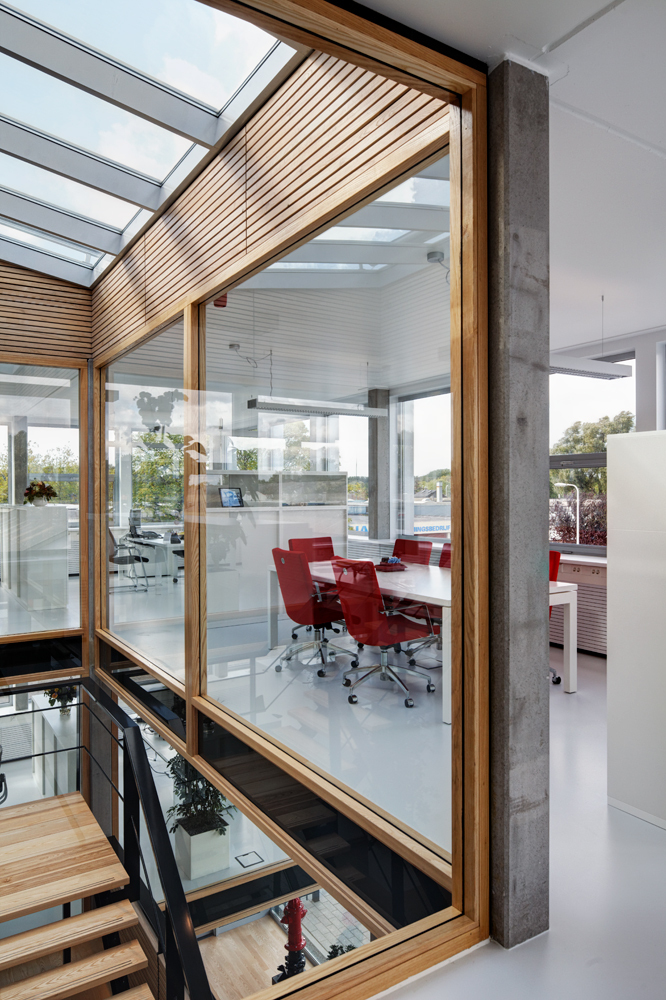
Recently, in Rozenburg (The Netherlands), the new office building was completed for Qualm, a contracting firm for earthwork, road- and waterworks. The building and interior are designed by Sputnik Architecture Urbanism Research from Rotterdam.

The working method of the company was the starting point for the design of the building. On the one hand, there is a need for concentration workplaces. On the other hand, the company is organized horizontally and informal communication determines the successful operation of the company.

The staff has their own workstations in rooms with different sizes for the different departments. These areas have a radiant white, design.
Especially for informal consultations and meetings the usual standard office hallway is transformed into a 3D walkway. This is an attractive area in which voids with stairs connect the three floors of the building spatially. The floors, the ceilings, the stairs, the office windows and parapets are all made of Ash. This creates a contrast between the formal and the informal atmosphere in the building.

The building stands on the site where the company Qualm has long been established, in an industrial business park of the 1960s. The building fits in this robust context with a modestly designed façade. Behind the aluminum paneling an inventive, sustainable VRF air conditioning system is hidden. All piping and equipment are incorporated in the parapet, leaving no need for suspended ceilings in the offices.

The building is made with a structure of precast concrete columns and floors, which have surprisingly slim dimensions. This allowed the realization of three floors of the building within the maximum allowable building height.

For the interior Sputnik has, besides choosing the office furniture, designed fixed furniture elements, such as the reception desk, the kitchen / bar element in the restaurant and the meeting places on the floors.


Status: Built
My Role: Architect

foto / photo: Rubén Dario Kleimeer

foto / photo: René de Wit

ADA 1 - Office Building "An der Alster 1" Hamburg, 2007


ADA 1 - Office Building "An der Alster 1" 

Hamburg, 2007

© J. MAYER H. Architects


Project Team: Juergen Mayer H., Hans Schneider, Wilko Hoffmann, Andre Santer, Sebastian Finckh, Marta Ramírez Iglesias, Georg Schmidthals, Marcus Blum
Competition Team: Juergen Mayer H., Jan-Christoph Stockebrand, Marcus Blum, Klaus Küppers, Hans Schneider

Invited competition 2005, 1st Prize
Project: 2005-2007
Completion: 2007
Client: Cogiton Projekt Alster GmbH, Hamburg

Architect on Site: Imhotep, Donachie und Blomeyer, Berlin with Architekturbuero Franke, Hamburg
Structural Engineers: CBP, Hamburg
Building Services: Energiehaus with Sineplan, Hamburg
Light Engineers: Andres – Lichtplanun, Hamburg
Landscape Architects: Breimann & Bruun, Hamburg
Photographer: Dirk Fellenberg


The building site is situated at the intersection between Hamburg’s lively downtown and its urban landscape that is rich in water and mature trees. It is at the transition from city to nature, and the gateway building to the bustling metropolitan core.

The horizontal striped facade with its floating “eyes” celebrates the view onto this unique context. A public park in front of the building continues the design strategy of the facade into the landscape. The “eyes” in the facade and the platforms in the park enable the places to meet and contemplate.

The office spaces serve both a generic spatial layout and specific moments related to the “eyes”. Large spans provide for various office layout configurations in
combination with balconies and climatically tempered outdoor spaces of the “eyes”. The eyes are just a bigger space inside the double skin facade, which work the same as the whole facade.

This kind of facade highly economizes on energy, because the windows of the inner facade can be used to ventilate. This is the reason why no additional air conditioning is needed for the office building. In Germany, the companies mostly don’t want buildings with air conditioning because of the high running costs. Furthermore an air conditioning is also problematic in terms of health conditions. In addition to that the concrete core activation system inside the concrete ceilings cools the building during summertime and heats it during wintertime with the help of water. The warmed surfaces allow lower heating costs in wintertime and thus save energy.

The office building “An der Alster 1” links its interior and exterior spaces to the public park in front of the building and to the city context of Hamburg, becoming a new anchor at the prestigious Aussenalster waterfront. 

JOH 3 - Residential Building


JOH 3 - Residential Building 

Apartmenthouse Johannisstraße 3
Berlin

© J. MAYER H. Architects
Project Architect: Hans Schneider
Main Facade (Photo: Ludger Paffrath)


Facade (Photo: Patricia Parinejad)


Gardenview (Visualization: Ludger Paffrath)


Apartment (Photo: Ludger Paffrath)


Section (Drawing: J. MAYER H.)


Project Team: Juergen Mayer H., Marcus Blum, Wilko Hoffmann, Filipa Frois Almeida
Competition Team: Juergen Mayer H., Thorsten Blatter, Marcus Blum
Invited competition 2008, 1st Prize
Project: 2008-2012
Completion: Spring 2012
Client: Euroboden Berlin GmbH

Architect on Site: Architekturbuero Wiesler, Stuttgart with Thomas Quinten Projektmanagement, Berlin
Structural Engineers: EiSat GmbH, Berlin
Building Services: Ingenieurgesellschaft Striewisch mbH
Building Physics: Ingenieurbüro Santer, Duisburg
Fire Security Consultant: Fire Safety Consult, Berlin and KLW Ingenieure GmbH, Berlin

Property development group Euroboden is realizing a unique residential building at Johannisstraße in Mitte, Berlin's downtown district. J. MAYER H. architects' design for the building, which will soon neighbour both Museum Island and Friedrichstrasse, reinterprets the classic Berliner residential building with its multi-unit structure and green interior courtyard. The sculptural design of the suspended slat facade draws on the notion of landscape in the city, a quality visible in the graduated courtyard garden and the building's silhouette and layout. Plans for the ground floor facing the street also include a number of commercial spaces. The generously sized apartments will face south-west, opening themselves to a view of the calm, carefully designed courtyard garden. Spacious, breezy transitions to the outside create an open residential experience in the middle of the city that, thanks to the variable heights of the different building levels, also offers an interesting succession of rooms. The units' varying floor plans and layouts indicate a number of housing options; condominiums are organized into townhouses with private gardens, classic apartments or penthouses with a spectacular view of the old Friedrichstadt. The integrated design concept, which incorporates everything from façade to stairwells, elevators to apartment interiors, promises a unique spatial and living experience with an eye to high design.

Los Angeles Skyscraper in 2040


Los Angeles Skyscraper in 2040


Designed by Houston Drum

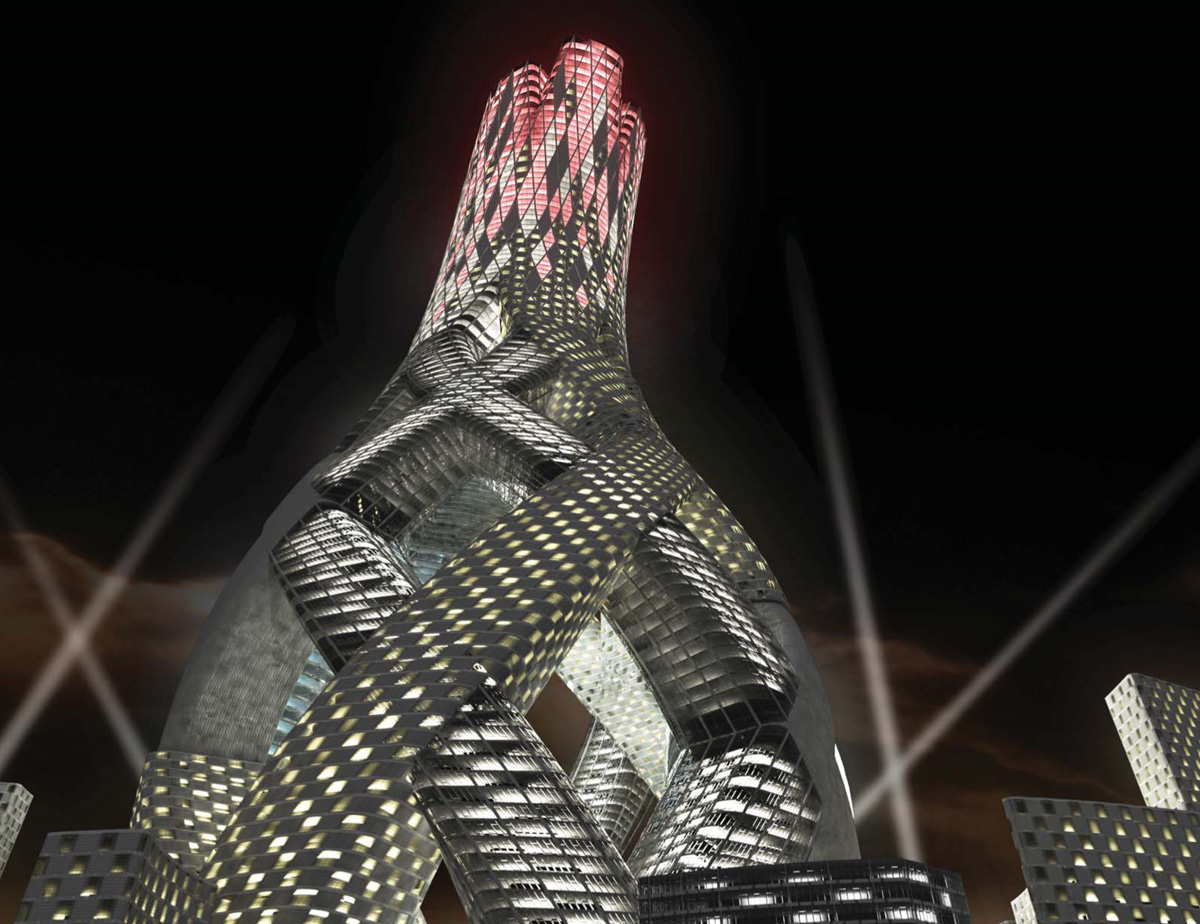
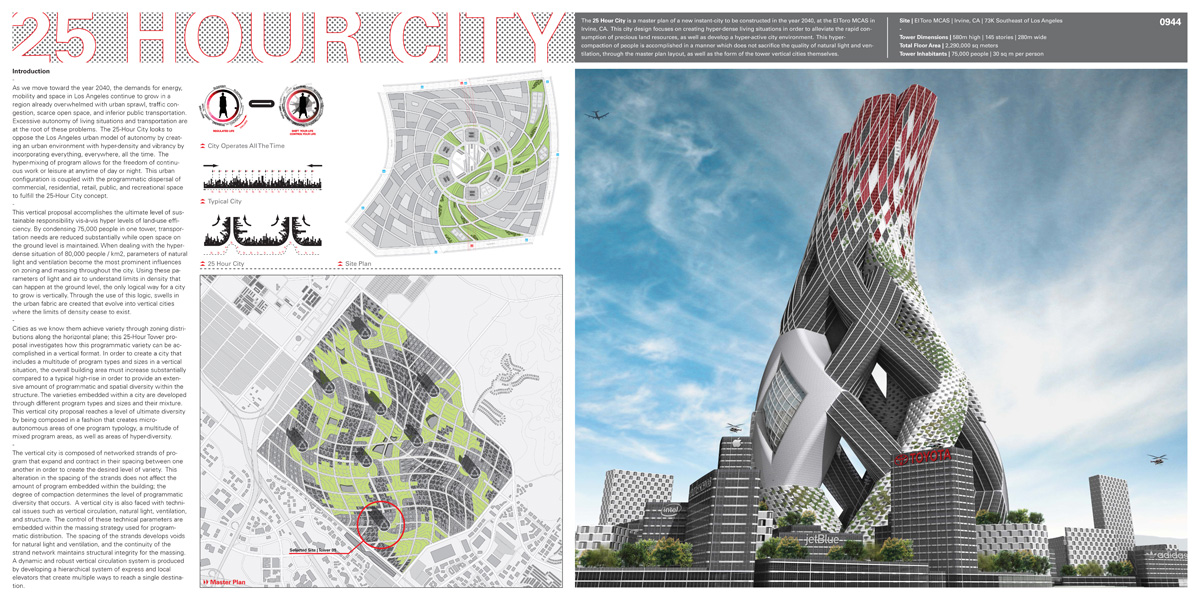
As we move toward the year 2040, the demands for energy, mobility and space in Los Angeles continue to grow in a region already overwhelmed with urban sprawl, traffic congestion, scarce open space, and inferior public transportation. Excessive autonomy of living situations and transportation are at the root of these problems. The 25-Hour City looks to oppose the Los Angeles urban model of autonomy by creating an urban environment with hyper-density and vibrancy by incorporating everything, everywhere, all the time. The hyper-mixing of program allows for the freedom of continuous work or leisure at anytime of the day or night. This urban configuration is coupled with the programmatic dispersal of commercial, residential, retail, public, and recreational space to fulfill the 25-Hour City concept.

This vertical proposal accomplishes the ultimate level of sustainable responsibility vis-à-vis hyper levels of land-use efficiency. By condensing 75,000 people in one tower, transportation needs are reduced substantially while open space on the ground level is maintained. When dealing with the hyper-dense situation of 80,000 people / km2, parameters of natural light and ventilation become the most prominent influences on zoning and massing throughout the city. Using these parameters of light and air to understand limits in density that can happen at the ground level, the only logical way for a city to grow is vertically. Through the use of this logic, swells in the urban fabric are created that evolve into vertical cities where the limits of density cease to exist. 

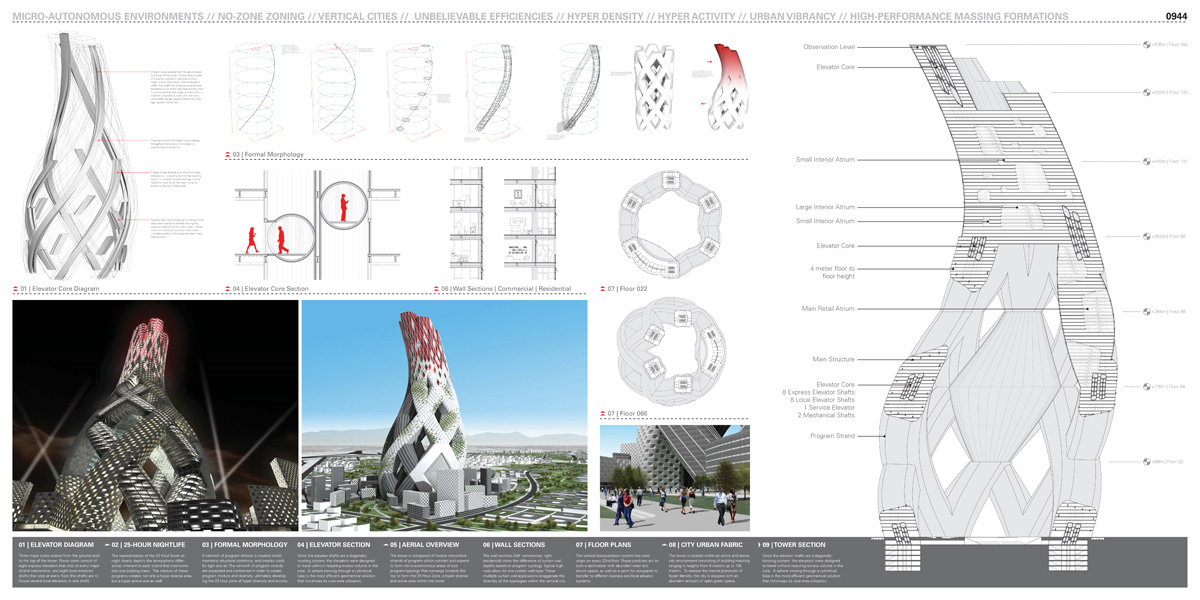
Cities as we know it achieve variety through zoning distributions along the horizontal plane; this 25-Hour Tower proposal investigates how this programmatic variety can be accomplished in a vertical format. In order to create a city that includes a multitude of program types and sizes in a vertical situation, the overall building area must increase substantially compared to a typical high-rise in order to provide an extensive amount of programmatic and spatial diversity within the structure. The varieties embedded within a city are developed through different program types and sizes and their mixture. This vertical city proposal reaches a level of ultimate diversity by being composed in a fashion that creates micro-autonomous areas of one program typology, a multitude of mixed program areas, as well as areas of hyper-diversity.

The vertical city is composed of networked strands of program that expand and contract in their spacing between one another in order to create the desired level of variety. This alteration in the spacing of the strands does not affect the amount of program embedded within the building; the degree of compaction determines the level of programmatic diversity that occurs. A vertical city is also faced with technical issues such as vertical circulation, natural light, ventilation, and structure. The control of these technical parameters are embedded within the massing strategy used for programmatic distribution. The spacing of the strands develops voids for natural light and ventilation, and the continuity of the strand network maintains structural integrity for the massing. A dynamic and robust vertical circulation system is produced by developing a hierarchical system of express and local elevators that create multiple ways to reach a single destination.


Hydropower financing:current trends and key issues


Hydropower financing:current trends and key issues


In the late 2000s the power sector in many countries experienced a major revolution. The old vertically-integrated, nationally owned power utilities were unbundled and the concept of freestanding independent power generating companies (IPPs) was established. This trend was part of a wider process of encouraging more private participation in the ownership and development of infrastructure, including hydropower and multi-purpose water projects. With this arrangement most projects were developed using the BOOT model (build-own-operate-transfer) under which a special purpose private company finances the scheme (usually on a non-recourse basis) and assumes virtually all of the project risks. In return it owns the infrastructure for the duration of the concession.

While this formula worked well for the thermal power sector, it quickly became apparent that the situation is more complicated when it comes to major water resources projects. In general the experience with projects such as large hydropower schemes has not been favourable, with many MOUs being signed between governments and prospective private developers, but few schemes actually reaching the construction stage. In many cases the main problem has been an inability to finance the project.

A number of Case Studies have been undertaken by the author. Although each is different, it is possible to detect certain overriding issues which dominate the private financing scene. They are:

1. RISKS dominate the availability and cost of finance, and are tending to migrate back to the public sector.
2. TARIFFS tend to be higher (than the public sector alternative) due to high soft costs, the layering of risk, and heavy debt service obligations.
3. FINANCIAL viability tends to compete with wider economic considerations, and it can distort the optimisation.
4. The PUBLIC SECTOR has yet to find a workable model for attracting private participation.

Faced with these problems, there is an increasing tendency to move towards something that is often referred to as a “Pubic-Private Partnership” – although this term has no clear definition and can mean different things to different people. The objective is to move towards come half-way project structure that preserves the best of both the traditional public sector model and the perceived benefits of private sector participation through a BOOT type of arrangement.

The structuring of a project (in terms of ownership, risk sharing, etc.) is often dominated by financing considerations. There is no single generic solution that can be applied to all projects, but the paper will discuss some of the key issues that arise in selecting the most appropriate financing model for a particular project.

Digital Beijing Building


The headquarters of the Basque Health Department designed by Coll-Barreu Arquitectos is an added attraction in Bilbao, known for its contemporary architecture. The mind blowing building is spreading over an area of 9,200 sq m.

Digital Beijing Building

Basque Health Department Building, Spain


solar photovoltaic power generation facility, it shows activities on solar power generation. This 315-meter-wide, 37-meter-tall facility is located in Anpachi, Gifu Prefecture in Japan.

Basque Health Department Building, Spain


The Piano House (China)


The Piano House (China)

This unique piano house was built recently in An Hui Province, China. Inside of the violin is the escalator to the building. The building displays various city plans and development prospects in an effort to draw interest into the recently developed area.


Blogroll

 
Design by Wordpress Theme | Bloggerized by Free Blogger Templates | coupon codes